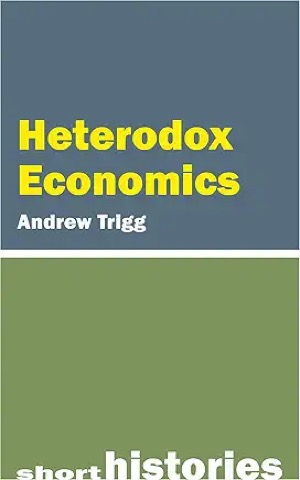
As a longstanding professor of economics at the Open University, and a founder member of the Association for Heterodox Economics, Andrew Trigg has deep competence in this field which is well expressed in this concise, erudite and yet very readable book.
The book falls into two parts, beginning with heterodox contributions in a history of economic thought, followed by the pluralistic dimension of heterodox attention to wider issues. His comprehensive heterodox history covers Marx, Keynes, Luxemburg, Kalecki, Kaldor, Robinson, Sraffa, Veblen, Galbraith, Pasinetti, Prebisch et al. Marx and Keynes identify information and transactional breaches in the Marshallian marginalist school of demand and supply and the dominance it gives to price theory. Savings leak from the system and don’t fund investment (p16) – NB all economics commentators! The quantity theory of money morphed into management of money by its price, the interest rate (p28). While Marx advocated revolution, Keynes argued for reform by management of effective aggregate demand. Wynne Godley developed stock flow consistent models and warned of a likely crisis from excess debt (p29). Institutional economics was developed by Veblen, Clark, Galbraith, Bourdieu, Lawson, and Hodgson. Kalecki, Baran and Sweezy critiqued monopoly capital. Others addressed financialization, neoliberalism, and globalization. Orthodox theory focusses on individual choice rather than on aggregates. Tony Lawson critiques the abstraction and lack of realism in economic theory (p68). Mathematics became economics’ answer to its physics envy, but derived correlations independently of any underlying intellectual theory, and so, according to Lawson, has ‘a life of its own’ (p108). Chapter 4 on pluralism covers colonialism, slavery, ecology, gender in a fascinating narrative.
Trigg concludes that “Heterodox economics must operate on two main fronts: it must sharply criticise the mainstream and pursue a genuine pluralism” (p110). But Geoffrey Hodgson is more critical, claiming that ‘too much plurality may lead to incoherence’ (Hodgson 2019), a charge refuted by Jamie Morgan in ‘Heterodox Economics’ by Lynne Chester and Tae-Hee Jo. It’s surprising that Trigg doesn’t reference this book, given that he contributed an endorsement.
There are gaps. The abstractions of orthodox theory which claim that realism of its assumptions is irrelevant if its conclusions refer accurately, Friedman’s 1953 ‘as if’ claim, is neither mentioned nor challenged (see Sid Winter QJE 1971, “Satisficing, Selection and the Innovating Remnant”). Trigg doesn’t show how heterodox economics has better answers to the dysfunctionalities of orthodox economics, from crisis to poverty to inequality to excess debt. His treatment of some heterodox contributions such as MMT, is cursory (p54) or of direct money financing, non-existent. He doesn’t cover behavioural economics or experimental economics as partial answers. Whilst Giovanni Dosi is mentioned (p77), it is too briefly. Dosi’s focus on agent-based modelling, but more importantly, his full inclusion of technology as a determinant of the economy is of major importance (see Dosi “The Foundations of Complex Evolving Economies”, Oxford 2023).
A further challenge to heterodox theory is not only to ‘criticise the mainstream’ but to develop a coherent alternative. Hodgson may be right that plurality, whilst welcome and necessary, may act as an escape route from this core and urgent challenge.
More Book Reviews
All Reviews
Expectations Matter
Aeons ago, it was a given that interest rates did not affect investment – and then it turned out that interest rates had been low and stable and so a lack of...
Keynes for our Times
Sadly, we have recently lost Robert Skidelsky who passed away in April this year. His monumental three-volume biography of Keynes established him as an eminent...
Recession
Thankfully, past periods of economic expansion have tended to be far longer than periods of economic contraction; indeed, the incidence of the latter has been...