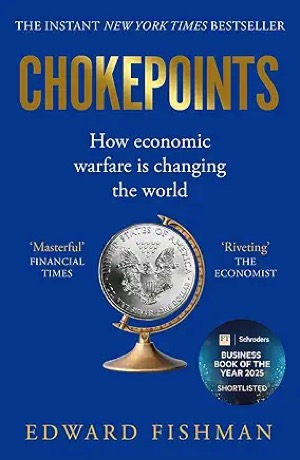
This is an account of the use by the United States of economic and financial sanctions as a weapon of foreign policy. The author is a former official of the United States State Department, the Pentagon and the Treasury, and he is now an academic. He gives the clear impression that he knows what he talking about.
The title, and main theme of the book, is ‘chokepoints’, which are specific goods and services that other countries need and of which the United States can control the supply. Chokepoints can be exploited to weaken enemies. Thus, excluding Iranian or Russian commercial banks, for example, from SWIFT, the worldwide inter-bank messaging system, can do serious economic damage to those countries by shutting them out of international payments. The fact that SWIFT isn’t American and therefore not subject to American jurisdiction can be readily overcome: the United States could impose sanctions on SWIFT unless it cut off banks from countries that the United States didn’t like (secondary sanctions). In fact, it didn’t even need to impose secondary sanctions; the mere threat that it would do so was enough to get Iranian banks excluded in 2012. America’s power stemmed from the ubiquity of the dollar in international payments: losing the capacity to handle dollar payments would have been fatal to SWIFT. And it was supposed that the United States could exploit Russia’s dependence on oil exports by imposing a low maximum price and imposing sanctions on anyone who bought oil or facilitated oil purchases (e.g. by shipping or insuring) at above that price.
Financial sanctions have some serious drawbacks, as Fishman acknowledges. They create incentives for evasion, which are countered by punitive penalties. But then they are hard to reverse, as the United States discovered when it wanted to ease sanctions in Iran: it had great difficulty in finding a commercial bank willing to take the legal risk of intermediating between the United States and Iran.
In the longer run financial sanctions stimulate the development of means of payment which don’t involve the dollar or the United States, such as could be provided by the swap line of $25 billion (equivalent) between China and Russia. There has been much comment about the possible use of the euro or the renminbi as reserve currencies; but perhaps the clearest indication of a flight from the dollar is the remarkable rise in the price of gold, driven by central bank purchases, which Fishman doesn’t mention.
As I write (March 2026), the United States and Israel are attacking Iran. Their objectives have not been made clear, but there has been much talk about preventing Iran from acquiring nuclear weapons. In 2015, the Obama administration, in concert with Russia, China, Britain, France, Germany and the European Union, reached an agreement which relieved sanctions on Iran on condition that it constrained its nuclear development programme by limiting fuel cycle activities that could lead to the production of weapons-grade uranium or plutonium. Iran’s nuclear facilities were subject to regular inspection by the International Atomic Energy Authority. In 2017, the Trump administration certified to Congress that Iran was complying with the conditions, but the following year it refused to do so and the United States withdrew from the agreement, contrary to the wishes of France, Germany and Britain. Exactly why is not clear, since the IAEA reported that Iran was in compliance until 2018; thereafter Iran refused access to the inspectors. Fishman can throw no light on it, having left the government in 2017. Whatever the reasons, sanctions haven’t provided a solution, just as sanctions imposed on Russia after its occupation of the Crimea and eastern Ukraine didn’t prevent it from invading Ukraine in 2022. And right now, Iran is exploiting its oil chokehold on the west.
The relationship between the United States and China is supremely important, and it has deteriorated greatly over the past thirty years, since long before Fishman’s narrative begins. During the Asian financial crisis of 1997-1998, China earned the gratitude of the rest of the world, including the United States, for resisting the temptation to devalue its currency at a time when those of many of its neighbours were collapsing. It thus helped to absorb part of the deflationary shock that the crisis had created. China was admitted to the World Trade Organisation in 2001. In the following ten years or so, there were some frictions in the relationship, over China’s exchange rate policies and accumulation of massive foreign exchange reserves, and over American resistance to Chinese purchases of real assets owned in the United States.
According to Fishman, the relationship soured in 2012, when the Chinese Communist Party issued a document warning that the West posed an existential threat to the Party’s control over China, and rejected liberal ideas including constitutional democracy, civil society and press freedom as ‘false ideological trends’. As to what China has actually done, Fishman cites the struggle for supremacy in digital technology and China’s use of it as an instrument of repression, and the Belt and Road Initiative (2013), which offered loans to other countries for infrastructure development. The relationship got worse during the first Trump administration, which resented the shift of manufacturing industries from America to China and China’s theft of American intellectual property, and set about imposing tariffs and other trade controls. ‘We were already at war’, declared the then U.S. Trade Representative Robert Lighthizer. Another factor, surely, was the expansion of China’s armed forces, which threaten Taiwan and possibly other countries in the region, though they remain much less powerful than those of the United States. And it is entirely possible that there have been other indications of hostility from China that are not in the public domain. America’s increasing hostility to China largely continued during the Biden administration, and into Trump 2.
Geopolitical tensions, aggravated rather than ameliorated by the attempt to identify and exploit chokepoints, are partitioning the world into two zones, China being joined by Russia, Iran, and such other countries as need their support, or that they can recruit for other reasons. Negotiating with the United States is difficult and dangerous because a new administration means potentially a new foreign policy every four years, and there is not much continuity. Meanwhile, the strategy of exploiting chokepoints seems unlikely to succeed in the long run against a group of countries with the physical and intellectual resources of America’s adversaries.
Rather a challenging outlook, then. Fishman’s book is written from an American standpoint, though not an uncritical or unthinking one. It provides a well-informed, well-written, and thought-provoking account of the use of sanctions so far, and is warmly recommended
More Book Reviews
All Reviews
Money Beyond Borders
This book is both easy to understand and pretty entertaining. Barry Eichengreen, Professor of Economics and Political Science at the University of California,...
The Price of Money
While a member of the MPC at the Bank of England, considerable time was devoted to thinking about two important concepts; the size of the output gap and the...
The Battle For Hamble
Bill Blain is best known for his long-running "Morning Porridge" market commentary — sharp, opinionated, and unafraid of a mixed metaphor. In The Battle for...