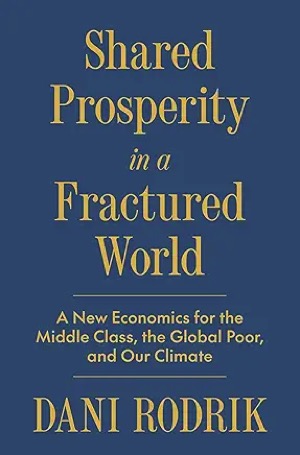
The world is being deliberately fractured, no doubt. But does it matter? Dani Rodrik’s latest book seems to say that it doesn’t. What truly matters, he argues, are democracy, prosperity, and sustainability—and all three, Rodrik believes, can be achieved together through a shared policy framework he calls productivism.
In his now remarkably prescient 2011 book The Globalization Paradox (see also Ian Bright’s 2018 SPE Review of “The Weaponization of Trade”), Rodrik famously argued that societies cannot simultaneously pursue hyper-globalization, democracy, and national sovereignty. As we all surely desire democracy (though, in 2026, I have to pause and ask), the real contest lies between hyper-globalization and sovereignty. In “Shared Prosperity in a Fractured World”, Rodrik leans towards national sovereignty, which is translated into productivism. Hyper-globalization needs international policy coordination or culture and, as much as we might wish otherwise, it has become painfully clear that even what international rules-based cooperation we had is being dismantled.
This leads Rodrik to advocate productivism: a call for any well meaning government to engage in deliberate, place-based experimentation to achieve explicit goals, even in their own interest (Sabel and Zeiltin, 2012). It is a pragmatic approach that challenges reliance in ideological dogma and the allure of certain solutions to complex problems. Clarity on the goals are important. Rodrik links old and new facts to lead us to consider a refreshingly new paradigm —that democracy requires a prosperous middle class to endure; that therefore the services sector, not manufacturing, now has to be the greatest contribution of growth even in the developing world; that hence we can’t expect high growth any more, and so we have to expect happiness not just through prosperity but through social wellbeing.
Broad in scope, “Shared Prosperity in a Fractured World” reads more like modern philosophy than popular economics. That is intentional. In his “Economic Rules: The Rights and Wrongs of the Dismal Science” (2015), Rodrik contended that economics’ strength lies not in one grand theory but in a pluralistic toolkit of models tailored to context. That same syncretism is on display here: time and again, Rodrik avoids forcing reality into any “one true model.”
Overall, this is a compelling book. I would recommend it to readers who want to be challenged—not by ideology, but by a pragmatic economist seeking to make sense of a deliberately fractured world.
Suggested References:
Rodrik, Dani. The Globalization Paradox: Democracy and the Future of the World Economy. W.W. Norton, 2011.
Rodrik, Dani. Economic Rules: The Rights and Wrongs of the Dismal Science. W.W. Norton, 2015.
Rodrik, Dani. Shared Prosperity in a Fractured World. Princeton University Press, 2024.
Bright, Ian. “The Weaponization of Trade.” SPE Review, 2018.
Sabel, C. F., & Zeitlin, J. . Experimentalist Governance in the European Union: Towards a New Architecture. Oxford University Press. (2012)
More Book Reviews
All Reviews
Money Beyond Borders
This book is both easy to understand and pretty entertaining. Barry Eichengreen, Professor of Economics and Political Science at the University of California,...
The Price of Money
While a member of the MPC at the Bank of England, considerable time was devoted to thinking about two important concepts; the size of the output gap and the...
The Battle For Hamble
Bill Blain is best known for his long-running "Morning Porridge" market commentary — sharp, opinionated, and unafraid of a mixed metaphor. In The Battle for...