
10 November 2025
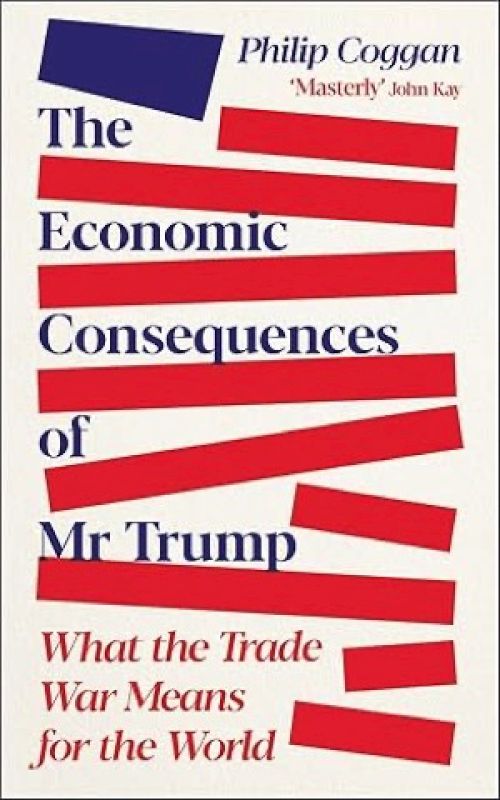
The Economic Consequences of Mr Trump
What the Trade War Means for the World
Philip Coggan
2025, Profile Books, 144 pages,
ISBN 9781805227687
Author: Philip Coggan
Reviewer: Geoff Crocker, Author, 'Rethinking Income and Money
In this short sharp blast Philip Coggan very effectively demolishes Donald Trump’s tariff policies. Coggan’s long journalistic career at the FT and Economist makes available a vast research database (20 pages of notes) which he deploys well to support his conceptual argument.
Trump’s tariffs appear to have objectives to:
- raise revenue to reduce the US internal deficit and permit tax cuts for the wealthy
- shift employment to US workers
- incentivise inward investment by global manufacturers
- use as a weapon to punish countries earning Trump’s disapproval for any other reason
Coggan rehearses the timeline of Trump’s erratic tariff announcements (p18-20), and the nonsense of the claimed ‘formula’ for country tariffs (p21). It’s an exercise in postmodernity power rather than Enlightenment logic. Chapter 2 sets out the benefits of globalisation and free trade, both theoretically from Ricardian comparative advantage, and empirically. Chapter 3 catalogues the actual effect of tariffs. Imported finished product and component prices increase, raising cost for US manufacture, and in both cases, making the US consumer poorer. Alternative US production will inevitably be at higher cost and/or lower quality since it has been deemed uncompetitive by consumer choice. Foreign manufacturers will face huge investment cost, higher labour rates, long timescales, and erratic Trump policies as disincentives to invest in the US. Tariffs will punish the US itself rather than other countries who will develop alternative trade patterns.
Here is a brief flavour of Coggan’s extensive data and incisive reasoning. 75% of the components of Mexican cars imported to the US originate in the US (p60). US produced goods have 45% import content. The US footwear industry faces devastation from higher import component cost. Tariffs have a proven adverse impact on economic growth (p63). Trump’s tariffs might raise $170bn in revenue but this is minimal in the context of the US $1.97tn deficit and would be negated by his planned tax cuts for the rich – extending the 2017 tax cuts would reduce revenue by $460bn (p90). 2018/19 tariffs had no significant effect on US employment (p72). 88% of jobs lost in the first decade of the 21st century resulted from automation, not from globalisation (p73). Automotive wages in the US of $14/hour compare to $20/hour work for McDonalds in Copenhagen (p77). 85% of employment is now in the services sector, not in manufacturing (p74). Walmart’s CFO predicts inflation from the tariffs, shoes and clothing will cost 15% more, unemployment will rise by 0.4%, and GDP will be lower by 0.7% (p89). Chinese imports cannot be easily replaced (p102).
Although Coggan’s book is short and powerful, it would still have benefitted from a concise one-page summary. Who is Coggan’s target audience? His familiar FT and Economist readers will probably respond well but will also probably already be aware of and persuaded by his argument. The 50% of Americans who voted for Trump are unlikely to engage. And in any case, as Coggan admits, the contest is not one of logic, but of power, and power exercised unpredictably and irrationally. ‘The President is unhinged’ declared a recent Guardian article (Guardian 5 October). That is the fundamental worry for tariffs and all areas of US policy and action, which no amount of careful logic can hope to confront.