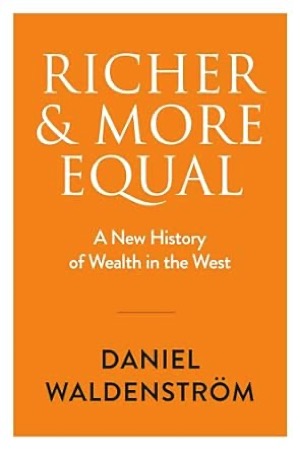
Peter Mandelson is notorious for many things, and one of them is for saying that he was ‘intensely relaxed’ about people getting rich. I suppose this might be because he thought this and that would be due to work efforts, enhancing productivity and output. However, this book tells different story and intends to counter the Piketty narrative with new estimates and more nuance.
In so doing, he sets out three key facts: 1 – We are Richer Today: there has been a rising tide and all boats have floated; 2 – Wealth is Different Today: assets are more based on housing and pension funds, which are also more even distributed across the populace; 3 – We are More Equal Today: while the wealth of the top 1% may have risen, that of the bottom 90% has risen more.
He challenges the Piketty assertion than capital is back at least over the long term, bringing to bear careful analysis of numbers across six main countries: France, Germany, Spain, Sweden, the UK and the USA. To present analysis going back over 150 years, as he points out, presents enormous difficulties of data collection, trawling through archive material and assessing others’ work. He points out that there is residual uncertainty but the main themes are sufficiently strong to be reliable. In this connection, it might have been helpful to have had more error bars or fans to illustrate how robust he judges the data to be.
He also challenges the conclusion that it is wars and the aftermath of wars which have generated decreases in inequality of wealth. He compares countries which were involved in the world wars with those that were not and finds the same trends. It is rising earnings leading to rising home ownership and the ability to save which have been the most important drivers of increased wealth and the proposition that it is not reducing wealth at the top that matters but increasing it at the bottom. His proposition, therefore, is that policy should concentrate on facilitating home ownership and the ability to save. Adding in state social security strengthens the equalisation as well, although of course such assets are not under the recipient’s control.
Finally, he looks at inheritance and the substantial role that this can play in perpetuating a given wealth distribution. What does all this add up to – and what might be missing? Firstly, simply understanding some of the nuances in the history should help us reflect – and, in particular, the importance of economic growth in facilitating the ability of individuals and households to acquire assets. We perhaps need to be more acutely aware of our own standards of life and how they are bought and maintained.
Second, there is a difference between theoretical wealth and accessible wealth. Many owners of landed estates would say that they are held in trust for future generations – people who are asset wealthy but income poor. The same might be said of many homeowners, the knowledge of rising house prices makes them feel wealthier but impoverishes their children who cannot get onto what we used to call the housing ladder but might feel more like a snake. An uncertain right to a future state pension might equally not feel like riches but there is an equally uncertain right to the proceeds of investment into stocks. As an aside, I once was howled down at a pensions conference for suggesting that funded and unfunded pensions were equally dependent on a future workforce. Without future workers, there will not be the profits to sustain investments, nor the taxes to support pay as you go pensions. Clearly, the group of workers on which you depend might be different – international assets versus local taxpayers for example – but the point holds good in my view. Nowhere, however, is the democratisation of wealth more obvious than in the ability in the West to live in retirement for 30 years.
The third missing story is the distinction between active and passive wealth. Wealth acquired because house prices rise in part because of restrictions on house building is passive and makes no difference to the output of the real economy, although the profits of the housebuilders will. There is now, here in the UK, substantial pressure on pension funds to invest in more local and more risky assets to support the growth of the economy and of course to grow pension wealth in the process. Naturally, pension funds look long-term and consider the flows of incomes needed by their pensioners. It will be interesting to see how this tension is resolved between policy makers, government, pension fund trustees and corporates. These considerations are responses to, rather than criticisms of, the powerful and careful work presented in this book, which has the added benefit of being much shorter than Piketty’s!
More Book Reviews
All Reviews
Powered by Projects
This is not an obvious book for macroeconomists to pick off a bookshelf, but it is nonetheless a good one. The author motivates us by a powerful narrative....

How to Win a Trade War
Trade is one of those subjects about which everyone has an opinion and almost nobody fully understands. Ask someone at a dinner party about tariffs, albeit...
Expectations Matter
Aeons ago, it was a given that interest rates did not affect investment – and then it turned out that interest rates had been low and stable and so a lack of...