
10 November 2025
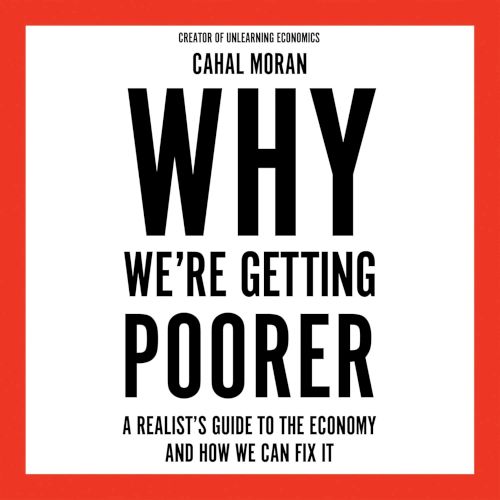
Why We’re Getting Poorer
A Realist’s Guide to the Economy and How We Can Fix it
Cahal Moran
2025, HarperCollins Publishers, 400 pages,
ISBN 9780008637958
Author: Cahal Moran
Reviewer: Kate Barker, Universities Superannuation Scheme
This book is quite a frustrating read. The author does not mean that we are all getting actually poorer, (although he provides sound accounts of types of inequality and points out that there are still too many people globally who are very poor). Instead, he means that because the economy doesn’t work well, we are poorer than we should be. He posits that there is “a complex web of practices, laws and institutions which shape it (the economy) in deliberate and changeable ways”.
Moran discusses a wide range of issues underlying inequality – including the contrast between workers essential to the economy (the Covid-19 experience) and the greatly increased number of billionaires. He makes a number of relevant observations – including that failing to provide good health care is damaging to the economy. Having commented on the appalling working conditions in factories in middle-income countries, or the conditions prevalent in cobalt mining, this is powerfully contrasted with the high-end image of tech products as they are being sold. These circumstances then enable the 2,781 global billionaires to exert influence on society – through their political lobbying, their development of ‘whimsical investments’ (Elon Musk) and even their philanthropic choices.
There is a thorough outline of difficulties in achieving social mobility, including prejudice and class. He cites the academic economic profession as one in which family background seems to play a particularly large role. The essential point here is that social mobility may be worthwhile but can still leave far too many people at the bottom leading miserable lives, and in places with a dispiriting lack of cultural capital.
Moran points out that some developing countries are still not getting their fair share of the tax take. For others, manufacturing has proved a good route to getting out of poverty. Universal Basic Income in every country is suggested, on the basis that often ‘just giving people money’ can offer them the best way out of poverty.
The second part of the book moves into a variety of topics – housing, money, inflation, and the fragility of the global economy. While these are all important topics, the solutions proposed are perhaps disappointing, although the importance of public land ownership to improving housing is one with which I strongly sympathise.
On inflation and monetary policy, he argues that dampening inflation by raising interest rates hits particular groups hard, and that inflation would be better managed by some form of collective bargaining. (Given the UK’s past failed experience here it is hard to regard this as a good solution.) His account of Spain’s more equality-based response to the energy inflation following the Ukraine crisis is interesting. However, these arguments did not really acknowledge that the hike in energy prices inevitably made the UK poorer as a country – the issue was about the policy of pain distribution. And looking back to the period of very low interest rates there were also concerns, albeit different ones, about the distributive effects.
The chapter ‘why did the global economy break’ (which I expected to be about the GFC) is slightly odd. It makes good points about the interdependences in the global economy, and the lack of resilience. He uses the example of US truck drivers – arguing both that they are the flexibility in the system, and that their working conditions have become too degraded. This exemplifies the more general issues we became aware of in Covid, that essential workers are often among the relatively low paid and/or have less good working conditions. However, it isn’t clear that, in Covid, the global economy DID break. It certainly stuttered, as you would have expected, but much of it worked rather well.
Moran’s main conclusion is that the problems he identifies could be ameliorated by more democratic participation. This does not mean in elections but in decisions at lower levels – such as more worker co-ops, or for housing, Community Land Trusts. He also argues for more rules of behaviour- suggesting that financial markets work well because they have rules (and fail when the rules are wrong or are flouted). Essentially this is a plea to tackle vested interests, and to move away from ‘we, the people’ (liberal democracy) back to demos. Urging the reader to engage in community wealth building, he nonetheless acknowledges that progress will be slow and will meet resistance.
While this book has some interesting examples and the basic argument is made, I felt it was in places too much of a polemic and failed to look at many issues in sufficient depth. It frustrated me as covering a less ambitious canvas and tighter argument could have enabled a clearer set of propositions for reform.