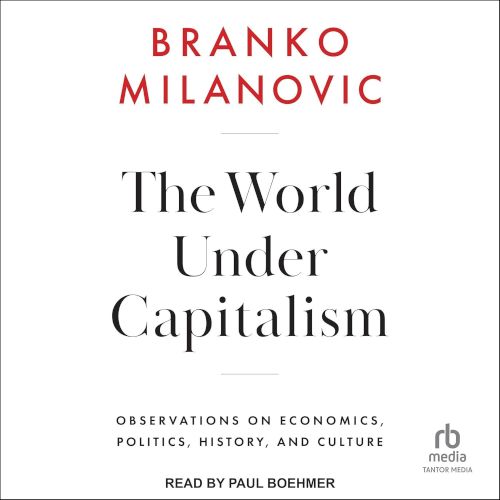
It was with trepidation that I asked to review this book. The author, Branko Milanovic, is respected and arguably best known for his work in global income inequality. He has worked in senior positions in the World Bank and published extensively. I was also aware of his Substack and blog which covers a wide range of topics from the history of economic thought, economic history, philosophy, current affairs, and climate change.
Many of these writings take a jaundiced view of mainstream Western views. I suspect that, being born and spending his early years in Yugoslavia / Serbia helped him develop an independent mind. I expected this book not only to challenge my views but also that I would be well out of my depth. I was correct about the first expectation but not the second. The writing is clear and concise making understanding of the points made fairly easy – even if you do not agree with what has been written.
The book is largely a collection of the author’s Substack and blog posts written between 2014 and 2024. There are a few speeches and op-eds. It is organised over five parts – the world under capitalism, inequality, globalization and multi-polar world, history and reflections. Each part has several essays no more than a few pages long. According to the preface, each is unchanged from when first published, correcting only typos and English language mistakes.
The author does not hold back when it comes to his opinions on several topics. This is especially so when discussing the degrowther approach to climate change. He is scathing in his assessment. Essay 1.2 titled “Degrowth: Solving the impasse by magical thinking” runs through the maths of increasing the income of lower income countries while restricting growth in more wealthy countries. “It is quite obvious that such a proposition is political suicide. Thus, degrowthers do not wish to spell it out.” (p.6). Essay 1.6 is a review of Kate Raworth’s book Doughnut Economics. I first read this review when it was published online at Brave New Europe in 2018 (see https://braveneweurope.com/doughnut-economics-sevenways-to-think-like-a-21st-century-economist-by-kate-raworth ). There is an extensive and respectful exchange of views between the Milanovic and Raworth in the comments below that review. This is despite Milanovic writing “Raworth’s ideal world seems to be one that we find in Giotto’s paintings of St. Francis, but it is not the world we inhabit.” (p.21) Essay 1.4 is titled “Is Norway the new East India Company?” It points to the contradiction between Norway being “one of the most active governments in highlighting climate change” (p.13) while being a major exporter of oil and gas.
When it comes to this reviewer expecting challenged, I found essay 4.4 in the section on inequality titled “The welfare state in an age of globalization” difficult. Milanovic notes the contradiction between the underpinnings of the welfare state (i.e. “the assumed commonality of behaviour or, differently put, cultural and often ethnic homogeneity” (p.89)) and the challenge of economic migration with the “inclusion of people with actual or perceived differences in social norms or lifestyle experiences” (p.90).” “There is no easy solution to the vicious circle faced by developed countries in the era of globalization.” (p.91) Perhaps I am being a wet liberal but I am less concerned about the lack of integration of migrants into society. As a statement of conflict of interest, I am an immigrant to the UK. Then again, I am white from a Christian/Australian background. Some may say I am therefore less culturally different than some other migrants.
I was surprised this essay did not mention Elinor Ostrom’s work on common pool resources. After all, the ability of a wide ranging and long-lasting insurance system relies on several of Ostrom’s design principles. There are further passages on migration. Essay 2.2 titled “Migration into Europe: A problem with no solution” is well worth the time partly because it takes the European Union to task for “a number of political blunders that have aggravated the crisis and created instability on its borders” (p.30).
Essay 10.6 is a thought- provoking essay on the Russia Ukraine war titled “What if Putin’s true goals are different?” published in June 2022. The war is partly looked at through the lens of Russia gaining sovereignty even if it means a loss of income. The essay is more wide-ranging than this but, when discussing sovereignty, the extremes of North Korea and Belgium are compared. One country (North Korea) is “practically unconstrained in its economic and political decision making” (p.239) while the other (Belgium) has various agreements that severely limit its economic and political decision making. “In terms of domestic policy, autonomy, or sovereignty, it practically has none. But it is rich”. (p.240). If Putin’s true goals are different, the author seems to argue that different approaches to full military support for Ukraine would be appropriate. On the trade-off between sovereignty and wealth, I was reminded of Dani Rodrik’s globalisation trilemma. https://www.aeaweb.org/articles?id=10.1257/jep.14.1.177 . Milanovic is not alone in his analysis here e – although Rodrik was examining a different issue.
There are a number of other thought-provoking essays, especially in “Reflections” section. Essay 16.1 titled “Non-exemplary lives” asks “Can you have a boring life and be a first-rate social scientist?” (p.395). Add to that essay 11.3 in the history section titled “On Eurocentrism in economics” and you have a highly critical view of mainstream western economic thought.
I have not read all the essays in this book. Then again, this is not a book to read cover to cover. It is like a well-prepared smorgasbord. Delightful when taken in small bites. Filling yet leaving you wanting more. I will be coming back for seconds and thirds.
More Book Reviews
All Reviews
Challenging Inequalities
This is an important book. It is the culmination of a five-year research project at the Institute for Fiscal Studies, which provides a detailed analysis of...
Powered by Projects
This is not an obvious book for macroeconomists to pick off a bookshelf, but it is nonetheless a good one. The author motivates us by a powerful narrative....

How to Win a Trade War
Trade is one of those subjects about which everyone has an opinion and almost nobody fully understands. Ask someone at a dinner party about tariffs, albeit...