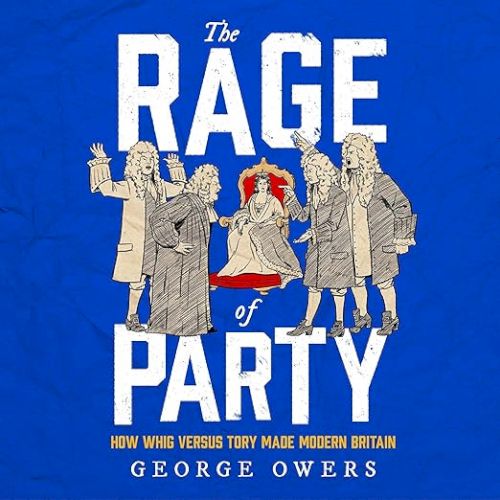
It might be that this is more of a meta-review than a review. I became interested in this book because the initial reviews stressed how the concepts it discussed had relevance to current day debates about Brexit, democracy and left versus right.Now I’m not so sure that these are not back projecting – but then that is interesting in itself.
The book is about the period between the accession (restoration) of King Charlies II and the death of Queen Anne. It was a turbulent period in which the terms Tory and Whig emerged, in which Kings were deposed, and in which parliamentary management became a key skill. At the start the divine right of kings was an important concept, while at the end a German prince with no English became a sovereign with much more limited powers.
Where are the themes which resonate today? One might be the unwillingness to be embroiled in foreign entanglements which might not meet our core interests. Back then, Whigs supported the need to resist Catholic attacks and to maintain a standing army to engage in land wars. Tories were suspicious of the taxes raised to finance such wars, particularly under a Dutch monarch. There could be a parallel here with the debates around Brexit, particularly when the Whigs were seen as protecting the interests of financial whizzkids in London against the sturdy country people who were penalised on their behalf. Thus far some parallels.
The theme of big state versus little state remains a key debate, though I am not sure how far this is especially key to Whig versus Tory. What is perhaps more telling is that in this period there were many changes of view and yet also of coalescence into the parties that we know today. Yet in turn these may be re-fragmenting into new coalitions and enmities. It was highly confusing then as it can be now. Keeping track of all the twists and turns while reading the book made my head ache. It is a period notable for not being covered in much detail in the school syllabus. One learns about the victories of Marlborough at Blenheim and Oodenarde without really being clear why they were being fought or what the eventual impact was. Having tried to get my head around all the movements between the Country Pary and the Court party, how people changed their tunes and equally the importance of Protestant splits on religious grounds, I can see why it is not made much of.
The theme of religious discord is crucial. Tories start with believing in the importance of obeying the sovereign but end by deposing one because he is Catholic. Anti-popery is a major battle cry for both Whigs and Tories but is thought of in different ways. More Whigs are Dissenters – more strongly Protestant and against established churches. It would undoubtedly be stretching parallels to cast these disputes into Christianity versus Islam. What might resonate, however, is the proposition that belief systems do matter. Of course, it’s always been the case that the same facts can be seen from different perspectives to enable opposite conclusions to be drawn. This period, which was turbulent and uncertain, offers good lessons in such differences of opinion. And if you think that social media is vituperative, unpleasant and insulting, just try the pamphleteers of the age. Debate was hardly about trying to change someone’s mind, and much more about finding the telling insult.
Printing had become more ubiquitous and literacy blossomed in its wake. Pamphlets were widely distributed and read and debated. I’m sure that many people found an echo chamber in which their prejudices could be entrenched, much as we all manage today. Parliamentary managers, such as Robert Harley who havered pretty consistently between Whig and Tory, were as much concerned with managing canvassing to produce election results as with managing the inchoate and shifting relationships in Parliament where whips had no party patronage to offer as they do now.
And so, to come to the meta-review: I am not convinced that the roots of our current debates really lie in, or are expressed through, the lens of this confusing period. Just because we are currently confused with the twists and turns of today’s attitudes and policy requirements as they were 300 years ago doesn’t mean that our debates are affected by those cultures. Yes, the standard of invective in Parliament is still pretty strong and some argue insufficiently civil. But it’s nowhere near as fierce as then. Religion may be important but is hardly as absolutely central as it was 300 years ago and many would struggle to imagine, in our secular age, how it could be.
And finally, what about international affairs? Those we now describe as Tories call for more defence spending and a wider definition of how we should engage on the world stage. Calls for closer engagement with Europe might be heard in some parts of the Labour party – but they are hardly Whigs whose interests then were in international finance and who were setting up the Bank of England to help finance the wars of William of Orange.
As ever, it is instructive to try and learn from history: after all Santayana pointed out that “Those who cannot remember the past are condemned to repeat it” which would hardly be ideal. But looking for parallels can be as destructive as enlightening, as with trying to judge those living in a different age by the standards of today. Let us not make such an egregious error.
More Book Reviews
All Reviews
Expectations Matter
Aeons ago, it was a given that interest rates did not affect investment – and then it turned out that interest rates had been low and stable and so a lack of...
Keynes for our Times
Sadly, we have recently lost Robert Skidelsky who passed away in April this year. His monumental three-volume biography of Keynes established him as an eminent...
Recession
Thankfully, past periods of economic expansion have tended to be far longer than periods of economic contraction; indeed, the incidence of the latter has been...