
14 April 2025
Rich World, Poor World
The Struggle to Escape Poverty
Ali A. Allawi
2024, Yale University Press, 688 pages,
ISBN 9780300214284
Reviewer: Leath Al Obaidi
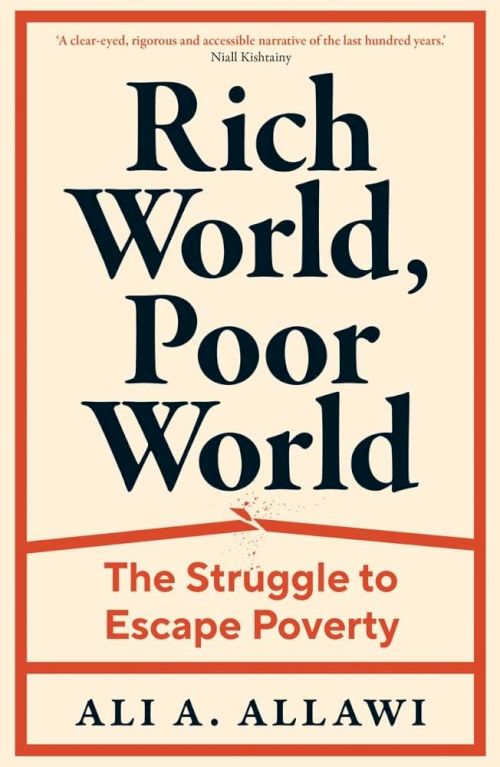
Recently, the International Monetary Fund warned that several poorer countries are at risk of severe debt problems due to rising inflation, higher interest rates, and unstable commodity prices. This highlights a key point in Allawi’s Rich World, Poor World: poorer nations do not exist in isolation. Instead, they are heavily influenced by powerful external forces that can disrupt even their best efforts to develop. This book provides a wide yet personal perspective on why global inequality still exists. Many economists approach this issue through theories or statistics, but Allawi’s view is shaped by his experience as an Iraqi policymaker—he was Minister of Finance after 2003—and his background at the World Bank. Educated at MIT and Harvard, he blends practical governance with academic knowledge, making his book both insightful and practical. Allawi begins by exploring how colonial history, the Bretton Woods system, and the global financial structure have long favoured wealthier nations. According to him, newly independent countries in Africa and Asia were left with weak institutions and little power in trade negotiations. As a result, they were forced into economic relationships that rarely led to real industrial growth. Even well-meaning global institutions, he argues, have often imposed rigid policies—such as rapid trade liberalisation and drastic spending cuts—that clashed with local realities and weakened fragile governments. One of the book’s key strengths is how Allawi examines development problems within their regional context, rather than treating poor countries as if they function separately. He focuses on Iraq, explaining that its economic and political struggles cannot be separated from the pressures of its neighbouring countries. Tensions with Iran, border issues with Turkey, political interference from Gulf states, and wider geopolitical rivalries all worsen Iraq’s internal problems. More broadly, Allawi argues that many low-income countries face similar cross-border challenges—rivalries between neighbours, ethnic tensions, and resource-based conflicts—which make simple domestic reforms insufficient for lasting growth.
Using his Iraqi experience, Allawi criticises “one-size-fits-all” solutions promoted by the IMF and World Bank. He argues that when a country has weak governance and faces external threats, applying standard policies like privatisation or subsidy cuts can lead to chaos instead of progress. He calls for a more balanced approach: stronger local governance, transparent management of resources (especially oil and minerals), and policies tailored to the political and economic realities of each country, including the role of neighbouring states. Although he acknowledges the success of East Asia’s developmental state model, Allawi warns that simply copying this approach in unstable countries may not work. If a nation is forced to spend heavily on security due to regional conflicts, economic development will suffer. He also highlights the resource curse, where heavy dependence on oil, gas, or minerals can lead to corruption and economic instability if governments fail to diversify their economies or collaborate with neighbouring states to build better infrastructure and trade routes. Allawi combines chronological historical analysis with his own experiences, this provides a well-argued critique of mainstream development thinking.
Rich World, Poor World presents a realistic but thoughtful perspective: true economic progress requires strong local institutions, fairer global trade rules, and careful consideration of regional influences that can disrupt even the most well-planned economic strategies. In today’s world, not only poorer nations but also richer nations face both internal challenges and, increasingly, pressures from outside forces emanating from the US and China. Accordingly, Allawi’s message on trade and security remains highly relevant.