
10 November 2025
Money: A Story of Humanity
David McWilliams
2025, Simon & Schuster Ltd, 432 pages,
ISBN 9781471195464
Author: David McWilliams
Reviewer: Richard Urwin, Chair, Saranac Partners Investment Committee
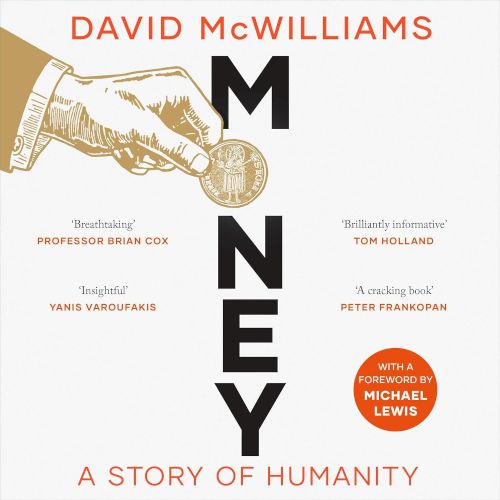
This is a good book, which I enjoyed reading. The reviewer has a longstanding interest in the history of money and credit. The book reminded me of events and theories that I recognised and placed them in interesting contexts, as well as informing me of aspects of the history which I did not know. The style is clear, making it an easy read, and potential readers from a broad range of backgrounds could benefit by doing so.
One objective of the book is to rescue the study of money from the narrow confines of conventional economics, where money is traditionally analysed as a medium of exchange, a store of value. Insightful perhaps, but also rather dry. McWilliams’ perspective is much broader. The central thesis of the book is that money is best viewed as the foundational technology which has ‘underpinned and animated human flourishing’ for the last 5,000 years, displacing fire in this central capacity. This pivotal role is still intact, with money ‘one of the foundation stones of organised societies today’. More generally, money is not simply a human creation. Anthropologists view humans as a ‘pyrophyte’ species, shaped by fire. McWilliams argues that we are better seen as a ‘plutophyte’ species, one which has adapted to and been adapted by money.
Of course, money itself has taken wide variety of forms, from tally sticks and tangible metals through to minted coins, bank liabilities and the complex institutional structure in which the modern conception of money is embedded. These transitions are dependent on associated changes in legal systems, technology, accounting and belief systems. However, it has not evolved in linear fashion: it is a technology which disrupts in the short time while facilitating long-term development. In this respect, it is Janus-faced. Money empowers, stimulating the development of markets, trade and productivity. However, it also corrupts, fuelling greed, corruption and periodic instability.
Does the book convincingly establish the central claim of the dominance of money as the definitive technology driving human affairs over many centuries? This is a strong claim, and while the discursive strength of the book means that its value is not uniquely dependent on its veracity, it is not clear to this reviewer that the ambition was demonstrably met. There is an abundance of descriptive material in the book, but it is not always clear how these interesting historical insights support or indeed undermine the central thesis. Roger Casement is a complex man worthy of historical investigation, but it’s not clear what relevance his Congo experiences have to the history of money. Individual chapters can seem more like stand-alone essays, rather than clearly illuminating the book’s central theme.
McWilliams is a creative user of metaphors and analogies – money is humanity’s operating system, a social superpower, a time machine – but it would be helpful for these to be more clearly connected to the book’s main claim. More formal frameworks could have been drawn upon more explicitly to support his central claim. For example, Graebner’s work on debt, and longer-standing frameworks such as commodity and credit theories of money, chartalism and mentalism, and network and information theory could all have made more explicit appearances.
More generally, the argument for the centrality of money in human development makes the assumption that money, like fire, is an entity with unchanging characteristics. However, McWilliams himself documents the constant evolution of the form that money takes. If its form changes, so does its impact: if bitcoin is money, its societal impact is not the same as the adoption of gold coins. This mutability makes it challenging to establish its role as constant, and more dominant than other technologies in shaping human development. I feel that there is a further, more formal book to be written for his central claim to be established, but this one is well worth getting to grips within its own right.