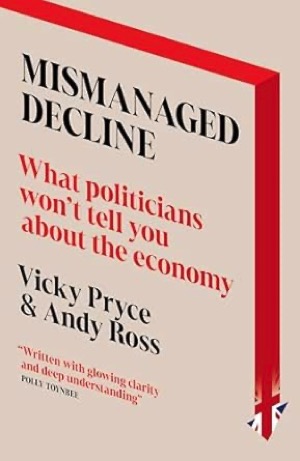
“Mismanaged Decline” is a hugely ambitious, wide-ranging and timely analysis of what has gone (and is still going) so wrong with Britain and what can be done about it. It defies conventional classification but is perhaps best described as a kind of ‘Everything You Always Wanted to Know About the Economy but Were Afraid to Ask’ handbook. It is also a good read – where else would you find Liz Truss rubbing shoulders with Alf Garnett?
Formally the book is in three sections – ‘How we got here’, ‘Current Issues’ and ‘Facing the Future’ - built around a masterly account of the rise and fall of Britain’s fortunes from the Industrial Revolution to date, augmented by a rich analysis of the domestic and global forces at work, right up to the dramatic shifting of the tectonic plates we are witnessing today. (Published last year, the authors were of course unaware of Trump’s latest horrors but presciently warned about “chauvinistic superpowers”, anticipating that the US would not take challenges to its top-dog status lying down.)
Throughout, the narrative is intertwined with an evaluation of the changing economic theories, fiscal and monetary regimes, politics and fashions which were driving policy responses. In the post-war period alone Keynesianism, monetarism and, exchange rate targeting have all come and gone in the search for a stability anchor - leading us most recently to a misguided and excessive reliance on a fiscal rules regime clearly not up to the task of rescuing the economy now.
The authors’ diagnosis is that the UK’s relative decline was inevitable but made worse by poor policy choices, of which Brexit was only the most egregious and we need to start moving closer to Europe again now. We are left stuck in a self-feeding loop of slow/zero growth, low investment, lagging productivity and strained government finances. Growth might not be everything, but no growth is a recipe for declining public services, a disillusioned population and a breeding ground for political extremism.
The final section looks ahead and provides guidance for what we can do now, recognising that there are many intractable issues with an increasingly difficult world environment. Unfortunately, it goes without saying that there is no easy fix and anyone (politicians) hoping for and relying on some sort of instant reset will be disappointed. The authors insist as a starting principle that ideology be eschewed in favour of evidence-informed policy making (unfortunately this still needs saying); at a minimum the government should be open about the sine qua non of more broad-based tax rises and more borrowing to invest in infrastructure, including human capital, if the foundations for a return to sustainable growth are to be laid. Economics is all about trade-offs and we can’t have everything - but the authors don’t sound particularly confident that politicians and the media are yet ready to be honest about what all this means for public services and tax.
Who is the book for? Everyone. The authors clearly intend it to be accessible to the general reader and, thanks largely to their careful and now-trademark conversational writing style, it is. The structure of the book – linking the narrative with the underlying economics as it goes along – works surprisingly well. The casual reader can dip in and out, with the middle chapters a happy hunting ground for today’s hot topics ( ‘The Stupidity of Brexit’; ‘Immigration: Why Can’t We Get it right’; ‘Environmental Imperatives or Green Wild Goose Chases?; ‘Inequality Matters’ etc) but readers who make the extra effort of reading from cover to cover will be well rewarded.
It should also be required reading for MPs, policy makers generally and, apparently, Treasury officials and advisers to the Chancellor who ought to know better.
PS Thirty years ago a strange thing happened to an economics book. Will Hutton’s “The State We’re In”, became a best-seller - not just a best-selling economics book, but topping the hardback non-fiction list for over six months. I think this is a better book but must confess I haven’t seen anyone reading it on the tube – yet.
More Book Reviews
All Reviews
The Winner’s Curse
It would be cheeky of me to say there is no need to review a book partially authored by a Nobel economic prize winner that is in its third edition. That...
AI for Economists
I started reading this book just as the UK Government announced the setting up of an AI Economics Research centre chaired by Nobel Prize laureate Simon...
Challenging Inequalities
This is an important book. It is the culmination of a five-year research project at the Institute for Fiscal Studies, which provides a detailed analysis of...