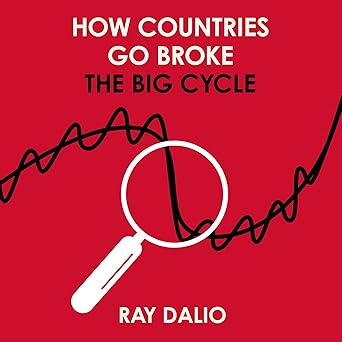
The timing of this book could not be better. With public sector debt at record levels in many major economies and borrowing continuing to rise there are real concerns that we will see a developed country government default on its obligations. Bond markets are already on alert as long rates have risen and yield curves steepened, whilst those whose finances are perceived as less sound (such as the UK) see an increase in the premium that has to be paid to raise funds.
Ray Dalio is known to many as a successful investor and founder of the Bridgewater hedge fund, which at one point was the largest in the world. His approach is to study history and look for patterns which repeat themselves. Hardly unique, but as Mark Twain said, “History doesn’t repeat itself, but it often rhymes”.
Dalio is looking for the rhythms that can be applied in his investment strategies. Here he is focused on what he calls the Big Cycle which is comprised of a series of short cycles each lasting six to nine years. The short cycles are the familiar inflation-interest rate cycles where a period of economic expansion results in overheating and higher inflation. Central banks then tighten monetary policy, growth slows, the economy often goes into recession and the cycle ends. Once inflation has ebbed, an easing of policy enables the next cycle to begin. However, as it is often the case that each new cycle starts with higher debt levels than the previous, there is a limit to how far loose policy can continue to stimulate growth. The burden of debt becomes increasingly unmanageable and debt service costs become unsustainable even at very low interest rates. Growth falters and there is a reckoning with the indebted economy facing the unpalatable choice of a period of fiscal austerity and debt re-structuring, or a monetisation of their debt. Debt has to be reduced and the choice made by each country will very much depend on how much pain they are prepared to take through austerity against the cost of inflating away the debt. The subsequent debt crisis is the point at which the “Big Cycle” comes to an end.
In this study, Big Cycles last around 80 years (give or take 25 years) and often feature a major break with the existing monetary system, be it the gold standard, Bretton Woods or as a member of a currency union. The pattern will be familiar to professional economists, but where this book will be of interest is in its description of debt crises, broken down into a series of common stages, and the empirical analysis of the adjustment to a more sustainable debt to income level. The book is rich in data going back over long periods and has plenty of tables and charts.
Much of the analysis focuses on the US, but there are also excellent country studies such as that on Japan where Dalio shows the impact on the central bank balance sheet and the costs to foreign investors and Japanese households of the long period of adjustment. In addition, Dalio reports on asset performance during debt crises for countries under fixed or floating currency regimes. Although the empirical analysis covers many different time periods and policy regimes, there are common features to each with gold outperforming and more generally commodities and equities consistently besting bonds. Although the author is not calling for an immediate end to the Big Cycle he does warn that we have reached a point where a major change in imminent. The burden of debt is limiting governments’ ability to tackle problems, thus helping to fuel populism. There are parallels with the experience of the 1930s where the public turns to populist solutions.
This is a big picture book and it is hard to disagree with the view that action needs to be taken to avoid another debt crisis. The growing tension between the US government and the Federal Reserve indicates we may be in for a period of fiscal dominance. Certainly, loose money and tight fiscal policy seem to be the only way that the economy can grow and the budget deficit improve. Dalio’s proposal for the US to aim for a budget deficit of 3% of GDP (half the current level) to stabilise the path of debt with a fallback position that the burden will be shared equally across all spending and taxes unless Congress agrees a different mix, would certainly focus minds.
Whilst “How Countries Go Broke” is a well-structured and good read, there are two areas I would take issue with. First, is the absence of any reference to the many past studies on these issues such as those produced by the IMF or OECD, or other books on the topic like Reinhart and Rogoff’s “This Time Is Different”. There is also an absence of sources for the data used in the charts and tables.
Second, the book is frustrating is in its lack of follow-through on the investment side. Dalio often refers to the fact that he has made great financial returns from his study of cycles, but as every investor knows timing is everything. Adverse trends can run for many years before the market experiences a Minsky moment and the music stops. As Keynes said: “the market can remain irrational for longer than you can remain solvent”. It would have been good to have had some pointers on what the author looks for in getting that timing right.
More Book Reviews
All Reviews
AI for Economists
I started reading this book just as the UK Government announced the setting up of an AI Economics Research centre chaired by Nobel Prize laureate Simon...
Challenging Inequalities
This is an important book. It is the culmination of a five-year research project at the Institute for Fiscal Studies, which provides a detailed analysis of...
Powered by Projects
This is not an obvious book for macroeconomists to pick off a bookshelf, but it is nonetheless a good one. The author motivates us by a powerful narrative....