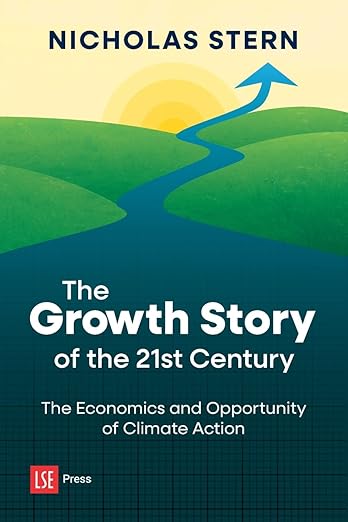
This is a hugely informative and important book. I was going to say it would make an excellent “primer” on the subject, but it is much more than that. It presents an insider’s account of the evolving global discussion of climate change, and an analysis of the issues which starts at first principles and ends with metaphysics. It is a polemic. Most importantly, it offers a prognosis which is concerned but nonetheless constructive. The clue is in the title.
Stern is a professor and chair of the Global School of Sustainability at LSE. He has held many other senior academic and official positions and has been writing authoritatively on climate change for at least twenty years. Whatever your views on the undecided issues, his eponymous Review for the UK government (“The Economics of Climate Change”, 2006) makes you nostalgic for the days when Treasury reports could be both rigorous and readable.
The four sections of the book are: Foundations; The New Growth Story; International Action; Galvanising Action. There are many useful and carefully-designed charts, diagrams and tables; almost ninety pages of references; and a helpful list of acronyms.
The key message is that the situation is serious, but not hopeless – or growthless. Indeed, measures taken to mitigate the risks will provide plentiful opportunities for future gains in living standards. This is music to my ears: the South East Wales Corporate Joint Committee is charged with delivering a bigger, fairer and also greener regional economy, and we are actively promoting and supporting the energy transition as we try to do so. Stern is frank about the increasing improbability of hitting near-term mitigation targets, but notes that the room for adaptation is overlooked, and will provide further opportunities.
I was also pleased to see Stern tackling head-on the idea that living with climate change somehow requires a completely different economic system. Despite its faults, there are no alternatives to what is (un)popularly called capitalism: “In other words, there is no viable practical alternative to an economy that utilises markets for the great majority of investments, decisions and actions.” (p378)
He also addresses what has seemed to me to be the biggest single obstacle to getting things done globally – namely, the need for significant resource transfers from wealthy to poor nations. He acknowledges the huge political difficulties, but notes that a start has at last been made.
The book is far from perfect. It is too long: it can be repetitive, it has too much purely expository content (“In this section we will…”), and it labours its points. In places it can sound platitudinous. In common with much other writing on the subject, its EQ falls short of its IQ: an overconfident advocacy of the economically “correct” position risks putting people off (as in the Brexit debate). In this context, repeated insistence on a “just” transition is needlessly pompous (“fair” works for me). The book steamrollers alternative viewpoints, and the ongoing debate about orders of magnitude. I think Stern has too much confidence in social science – he takes “growth theory” seriously – and maybe places too much trust in “the” science more broadly.
He is preoccupied with investment: spuriously-precise (big and global) amounts are specified, but few project details are provided. This perhaps leads him to overlook the potentially important role to be played by altered consumption (which is after all the bulk, and ultimate goal, of economic activity). A substantial proportion – estimates suggest around a half – of today’s carbon-based energy is wasted in production, transmission and usage. Meanwhile, a better-off world is consuming more and more intangibly and can surely be incentivised to continue to do so.
I also think that – as in his 2006 Review – he may be a little naïve on the subject of discounting future benefits and costs. “In my view it is not easy to find a persuasive ethical argument in favour of applying a value to a future life, identical except for date of birth, which is different from that applied to a life now” (p98).
For me, these flaws are worth putting up with. The book is a magisterial and positive discussion of the biggest issue of our times.
More Book Reviews
All Reviews
Powered by Projects
This is not an obvious book for macroeconomists to pick off a bookshelf, but it is nonetheless a good one. The author motivates us by a powerful narrative....

How to Win a Trade War
Trade is one of those subjects about which everyone has an opinion and almost nobody fully understands. Ask someone at a dinner party about tariffs, albeit...
Expectations Matter
Aeons ago, it was a given that interest rates did not affect investment – and then it turned out that interest rates had been low and stable and so a lack of...