
10 November 2025
Breakneck: China’s Quest to Engineer the Future
Dan Wang
2025, Penguin Books Ltd, 288 pages,
ISBN 9780241729175
Author: Dan Wang
Reviewer: Joe Little
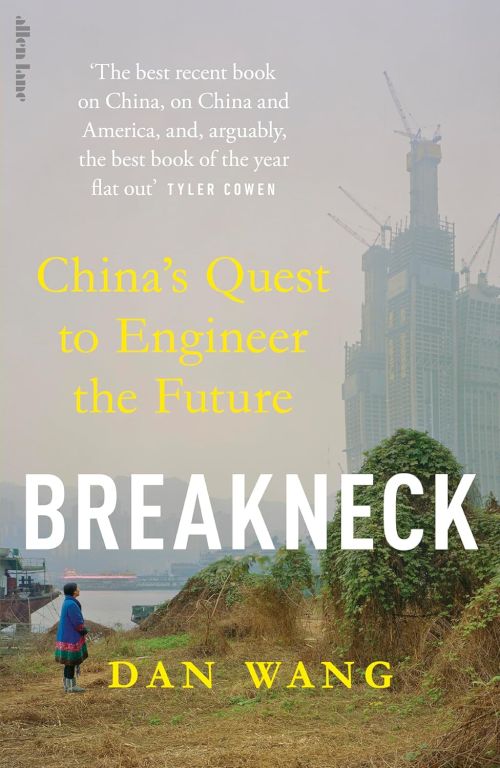
On the front cover of Dan Wang’s new book, Breakneck, the economist Tyler Cowen endorses it as “the best recent book on China… and the best book of the year”. While I can list a few other recent books on China I have enjoyed as much (Keyu Jin’s The New China, for example), Cowen might well be right on the latter. It’s a terrific book and, unsurprisingly, is a hot favourite for the economics book of the year prizes.
Wang is a Canadian, who has lived in both the US and in China, and is now a research fellow at the Hoover Institution. He is widely regarded as one of the West’s favourite analysts of modern China. And his detailed annual letters on Chinese society are celebrated for their macro insight, as much as for their writing style and communications skill.
Breakneck is part modern economic history, and part China travelogue. The title comes from Wang’s whizzy description of the China growth miracle, and the impressive infrastructure it has yielded, even in the tier-2 and tier-3 cities he writes about, such as Chongqing or Guiyang.
The principal idea of the book is to contrast China’s engineering state with America’s lawyerly state. It’s a fresh framing of the issue that the two societies are governed under different logics and organising principles. China, with its many trained engineers and focus on investment, versus the US, with a multiplicity of regulatory restrictions, slowing down investment progress. The fun distinction helps us to rationalise China’s new infrastructure marvels, alongside an apparent engineering decline in the US.
Perhaps the most interesting insight in Breakneck is Wang’s idea that Chinese progress comes from process development, not just infrastructure spending. As manufacturing capacity develops, it has supported new ecosystems and local supply chains. Through a sequence of mimicking, learning-by-doing, and opening-up to US competition, we can understand how China attained its leading position in many areas of global tech and manufacturing (the story of BYD is a particularly good example).
But there are dark sides to the engineering state too. In Wang’s view, this is not so much an issue of “going fast and breaking things”, more a case of the engineering mindset leading to mistakes. In one chapter, Wang describes the harrowing realities of China’s one child policy. In another chapter, he describes the intense lockdowns and surveillance in the latter phases of the zero-covid rules.
The conclusion of the book is that the story of Chinese development contains lessons for both the US, and for China’s future. Wang argues that the US needs to learn to build again. While for China, Wang argues that the lawyerly state, with its procedural safeguards and protection of personal freedoms, contains lessons for how China can sustain its growth miracle.
Wang’s account is thoughtful and enjoyable reading, but there are some issues. First, the storytelling style is anecdotal, rather than data-based or forensic. That’s not necessarily a problem, but it’s also not to everyone’s taste. Second, the consideration of the US is weak. That’s maybe not surprising – this is a book about China. But the final chapter on US applications can be completely skipped, without losing anything.
Third, there’s no discussion of Europe, which I think would have added a lot to the story. The juxtaposition between the engineering state, the lawyerly state, and Europe’s museum economy seems important to me in today’s complex, and multi-polar world.
Europe is already built, old, and risk averse. But, of course, rapid investment is not the only route to growth. Ideas and the intangible economy may be even more important. A notion that comes through clearly from the research of this year’s Nobel prize winners. It’s also something that is familiar to European economists from the ground-breaking Draghi report. Or for China watchers, with its prominent consideration in China’s latest 5-year plan. I think this angle would have added a lot to the book. Maybe Wang will return to the topic in his forthcoming annual letter?
All said, Breakneck is a terrific book, and a highly enjoyable read. It’s probably not the best economics book on China that I’ve ever read. But I’d certainly agree with Tyler Cowen that it’s the best new book that I’ve read this year.