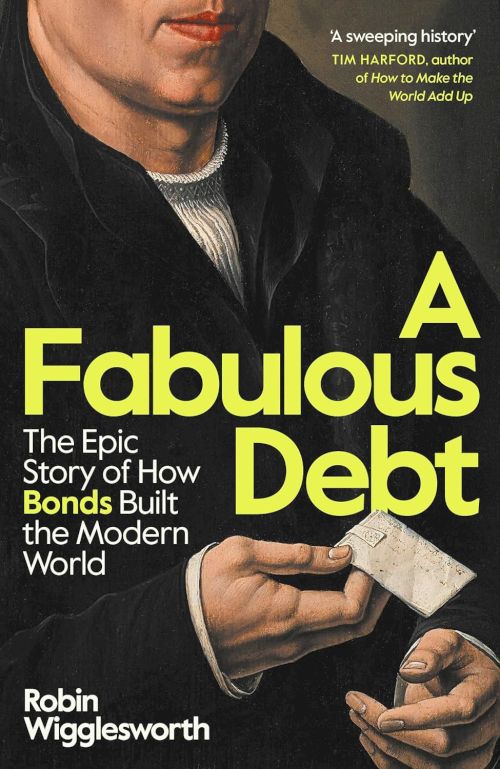
With global bond markets making headlines and bond yields at multi-decade highs, the new book by FT Alphaville editor Robin Wigglesworth, “A Fabulous Debt”, couldn’t be more timely. Its ambition is a great one: providing the first comprehensive history of the bond market.
The book does deliver. Starting in the City of Venice in 1171, which issued the world’s first proper bond, an interest-bearing tradable loan to fund its war against Constantinople, “A Fabulous Debt” takes the reader on a vivid journey of the ever-growing international bond market.
We learn about how bonds issued by Dutch local authorities to fund dyke building in the 17th century connected investors across the Netherlands and created a catalyst for the economic growth that ensued. Government bonds issued by Britain and the United States at an increasing scale to finance wars and territorial expansion became the dominant safe asset for savings and investment, thereby acting as a cornerstone of the Industrial Revolution.
The first proper corporate bond market was established by US railway companies in the 19th century. Since then, the rapidly increasing liquidity of bonds, both public and private, has contributed to the familiar cycle of growth, crisis and recovery.
The end of Bretton Woods in 1971 marks a turning point – both for the bond market, and for the book. The historical account up to this point, told through many curious but at times rather shallow anecdotes, left me somewhat longing for a deeper analysis of the fundamental role of bond market debt in enabling the global spread of capitalism and emergence of the modern state.
To me, it is the second part of the book that is most fascinating and illuminating. It is here where Wigglesworth’s strengths as a journalist, financial market expert, and storyteller become grippingly effective. Unshackled from the gold standard and barriers to cross-border financial flows, the bond market gained in size and complexity at an extraordinary pace after the fall of the post-war fixed exchange rate system.
Wigglesworth tells the stories of the many financial innovations that started proliferating through the perspective of key (mostly but not exclusively Wall Street) characters. This includes Drexel’s Michael Milken’s role in the establishment of the high yield “junk bond” market, experiments with mortgage-backed securities by Salomon trader Lewis Ranieri, and Ralph Cioffi at Bear Stearns, whose failing derivative funds in 2007 set off the first alarm bells of the Great Financial Crisis.
Recent bond market news is consistent with the two striking facets of the bond market which have characterised it since it took off a millennium ago, and which Wigglesworth highlights throughout the book. On the one hand, the market’s innovations and adaptability facilitate economic growth and help build state capacity. Its exploitation, on the other hand, by both investors, intermediaries, and issuers, sets it up for regular ruptures that often spread beyond the realm of financial markets.
More Book Reviews
All Reviews
1873: The First Great Depression and the Making of the Modern World
This book is the second to be written by Liaquat Ahamed. He made his publishing debut back in 2009 with “Lords of Finance: The Bankers Who Broke the World”...

Reindustrialise Britain: A Strategy for Wealth Creation
The nearest thing to an epiphany I had as a student came when I read an early paper (by Dennis Snower, I think) on the “insider-outsider” model of the...
Monetary Economics and Policy: A Foundation for Modern Currency Systems
I enjoyed reading this book. It covers a wide surface area of monetary economics, and I think it will be useful for people studying the subject. It is...