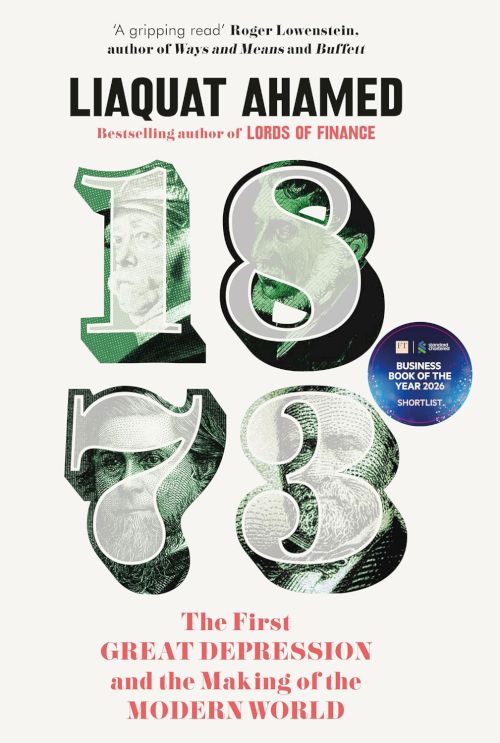
This book is the second to be written by Liaquat Ahamed. He made his publishing debut back in 2009 with “Lords of Finance: The Bankers Who Broke the World” which focused upon the run-up to the Great Depression of the early 1930s and which garnered much by way of accolade. Indeed, it won a series of awards including the Pulitzer Prize for History and the Financial Times’ Best Business Book of the Year award. Undeniably, therefore, a hard act to follow. Already, though, “1873” has been shortlisted in the contest for this year’s Financial Times’ award.
With nobody sure how long the massive and frenetic AI investment boom will last the book has attracted much attention on the part of investors by dint of its focus upon the US railway building mania of the period – and its subsequent massive implosion. Ahamed’s ambit, however, is very considerably wider, and markedly more ambitious, than this. Indeed, his subject matter comprises what has long been accepted as constituting the first-ever global financial crisis. Charles Kindleberger, for instance, cited this episode in his classic “Manias, Panics and Crashes” while Harold James devoted an entire chapter to this chain of events in his “Seven Crashes: The Economic Crises That Shaped Globalisation” published three years ago (and reviewed on this site). Ahamed’s subject matter, therefore, is hardly untrodden turf.
But if his subject matter is hardly new, his approach most certainly is, insofar as he tells the story the boom and bust experienced by both return-seeking assets and economies which occurred during the late 1860s and 1870s by means of a four-tier temporal framework: the boom: 1867-1871; euphoria: 1871-73; the bust: 1873-1876; and, finally, the aftermath: 1876-86. Within these four categorisations are a series of bite-sized chapters, almost twenty in all, which describe those cardinal aspects of the period which Ahamed believes casts most light upon the phenomenon which is being analysed.
Ahamed’s approach, moreover, is far from dry and academic. Indeed, the story of the genesis of the first global financial convulsion is told with flair and wit, with manifold (and, generally, colourful) descriptions of key players, whether bankers, borrowers, politicians or commentators. My favourite section in this regard is that which focuses upon Walter Bagehot (a distinctive voice of caution as the financial speculation builds) and Anthony Trollope (whose novel “The Way We Live Now” focuses upon what he describes as “the commercial profligacy of the age”). Indeed, much of Ahamed’s story is focused upon the surfeit of mendacity which characterised the pre-1873 upward move in markets and the multiple “bezels” (to borrow JK Galbraith’s wonderfully descriptive phrase) which flourished amidst the froth and speculation of asset market booms – and which generally only become evident when previously soaring stock, bond and property markets collapse.
Such an approach lends itself to readability. Indeed, another reviewer has described the book as a “page-turner”: rather hyperbolic judgement for my taste. It is, nonetheless, easy to see why the phrase was deployed. Ahamed certainly knows how to grab a reader’s attention and, subsequently, to hold it in a determinedly firm grip.
The book also carries an authoritative tone. And rightly so, as Ahamed has clearly done his homework. The book’s copious notes and bibliography indicate that Ahamed has been diligent in accessing all available secondary sources. And while he isn’t explicit about his primary research, it is increasingly evident, as one progresses through his narrative, that he was ploughed through much by way of official records and newspapers, with The Economist magazine (established as long ago as 1843) – and described, we learn, by Karl Marx (to whom, incidentally, much of one chapter is devoted) as “the organ of the aristocracy of finance” – providing especially pivotal source material.
As a long-practising economist, however, I do have a couple of reservations about the book. The first concerns the wholesale lack of market or macroeconomic data, whether in tabular or graphical form, contained therein; I found this disappointing. Frequently Ahamed refers to rates of GDP. Industrial production or world trade growth but without providing anything substantive by the way of detail. A similar approach is taken vis-à-vis the behaviour of key financial markets. Such information interspersed amidst the text or, alternatively, contained in some sort of data annex would have proved immensely helpful to a reader seeking to get a clear sense of the relative magnitudes of the pre-1873 global economic and market boom and subsequent bust.
The second reservation relates to Ahamed’s attitude towards the sustained price deflation which characterised the post-crisis global economy. Ahamed wholeheartedly accepts Milton Friedman’s argument that the US abandonment of bimetallism and embrace of the gold standard was the prime cause (Friedman described this policy shift as the “Crime of 1873”) of this phenomenon. Ahamed appears, moreover, to think such sustained price deflation constituted an unmitigatedly bad outcome. In my view, it would be more appropriate, in this connection, to make to make a clear distinction between “good” and “bad” deflation.
More Book Reviews
All Reviews
To Think Like a Statistician
Statistics professor Susan Holmes said that statistics is like Poland, perpetually surrounded by powerful neighbours — probability, mathematics, applied...
Exile Economics: Tariffs, Trade Wars and the Future After Globalisation
Ben Chu addresses the challenge to global trade triggered by Donald Trump’s erratic tariff policy. His background and skills as an economics journalist are...

What Happened to Liberal Democracy? Remaking a Politics of Shared Prosperity
My mother didn’t go to university although she might well have done had not the Second World War intervened so that she joined the WAAF. She described her...