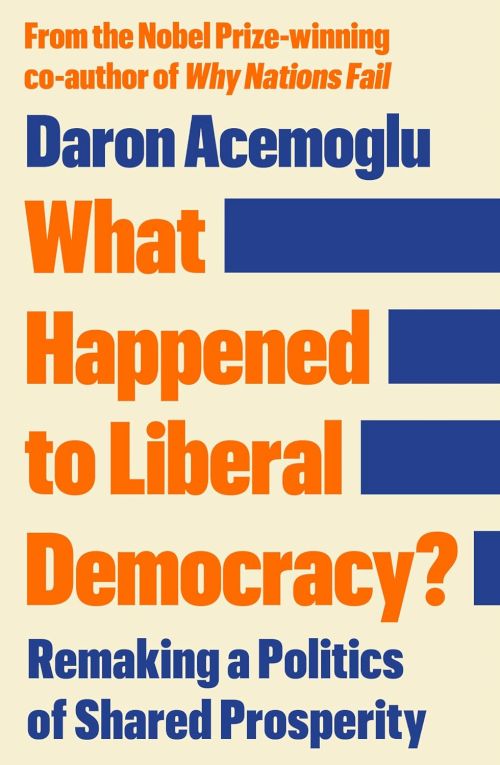
My mother didn’t go to university although she might well have done had not the Second World War intervened so that she joined the WAAF. She described her experience in the WAAF as fundamental to her understanding of society as she learnt that people from very different backgrounds and school experience were just as effective and could become good friends too. This building of a community of people would be recognised in this book as an asset which we have been undermining in a mistaken definition of the meaning of liberal democracy.
This is a dense book and covers a lot of ground so an attempt to summarise its argument may well lose exactly the nuance that Acemoglu wishes to insist upon. Nonetheless here goes.
Over the last several decades, the liberal consensus has buckled, partly under its own success and partly as a result of technological change which has opened up a significant gap between college educated and non-college educated people.
That gap is partly in economic circumstances which have increased inequality between these groups, and partly in the standing of these different groups. Further, he argues that in the college educated group there is a further distinction between the elite – much higher earnings and often in the tech sector – and the larger ‘mass-college’ group. He has a telling anecdote of attending a conference on inequality which he expected to be about earnings, and the education divide, only to discover it was about diversity and inclusion. He attributes this to the creation of a mechanism which works for the college group as a whole and therefore enables them to avoid focusing on the non-college group.
This attitude has in turn led to a focus on social engineering which he regards as pernicious. Of course, he shows that all communities engage in social engineering of the kind which creates shared values; this is essential to creating shared narratives and norms – though norms can also be a cage.
There is powerful analysis of the ways, both good and bad, in which norms can be created and enforced covering early Christianity, Islam, Chairman Mao and cancel culture. The aim is to identify the processes which help empower, allow self-government, and voice or alternatively do the opposite!
The nuance is in navigating the inevitable tension between creating shared values and imposing them. In a parallel which is not in the book, the Rousseau concept of the ‘general will’ was used to justify the Terror in the French Revolution. The general will can be invoked by those who ‘know best’ and then is to be imposed on the rest. It has been identified as a step on the way to authoritarianism even when the perpetrators of Terror do so with the highest possible motives to build a better and more enlightened world.
Liberal democracy must allow dissent, buttressed by the ability to exit a community. Debate should be its lifeblood, not silencing critics.
What does this mean in practice? I was a bit disappointed that an approach to regulation was only reached on p290 of 300. Acemoglu wants to see government intervention in AI and social media, while actively deregulating elsewhere. Social media must be prevented from harming real communities by amplifying divisive voices. AI needs to be turned into a tool which is pro-worker to support the non-college educated and support the skills of ordinary workers, not just to replace them. This is one of the key threads in the book and the basis of a key policy prescription to adapt how AI is thought of and used.
And what about immigration? It’s a theme of the book that reasonable positions have been demonised inappropriately and the concerns of those who feel disempowered by immigration ignored. While it may be the case that immigrants have not undermined the wages and jobs of the relatively unskilled, it is certainly the case that the less educated have lost out. It is perhaps optimistic to think that addressing the underlying problem of the loss of manufacturing jobs or increasing the productivity and wages of less well-paid service sector workers will make them more accepting of immigrant communities. Acemoglu certainly recognises that creating an integrating shared narrative needs a lot of work.
It’s a bold step to talk about a working-class liberalism, when in many quarters the concept of a ‘working-class’ has been played down as no longer relevant. And in some ways it is an over-simplification since outside the ‘historic’ working class there are other groups who feel marginalised and overdominated by a narrative which privileges non-native populations. However, the analysis of how social engineering has stepped too far into coercion, and how liberalism needs an acceptance of dissent and variety to build shared prosperity is a very powerful one with which I agree.
I live in a village and attend church. I agree that face-to-face communities are important. A recent message from the Labour rural affairs Minister appeared to suggest that sitting in a pub with a dog (a black Labrador) at your feet is symbolic of far-right attitudes. Such descriptions of rather normal behaviour could be taken as an example of the polarisation of approach and a disdain for difference that serves liberal democracy rather poorly and fails to engage in the support that communities need – and that the Minister said that she wanted. The case that Acemoglu makes is powerful and well-made and the book is a great read which deserves careful attention.
More Book Reviews
All Reviews
1873: The First Great Depression and the Making of the Modern World
This book is the second to be written by Liaquat Ahamed. He made his publishing debut back in 2009 with “Lords of Finance: The Bankers Who Broke the World”...
How To Think About AI: A Guide for the Perplexed
Richard Susskind’s ‘How to Think About AI: A Guide for the Perplexed’ offers a clear and thoughtful introduction to an inherently complex and...
Prosperity Through Growth
What creates prosperity, and why do countries that have become rich sometimes seem to forget how they got there? We have covered this in previous SPE book...