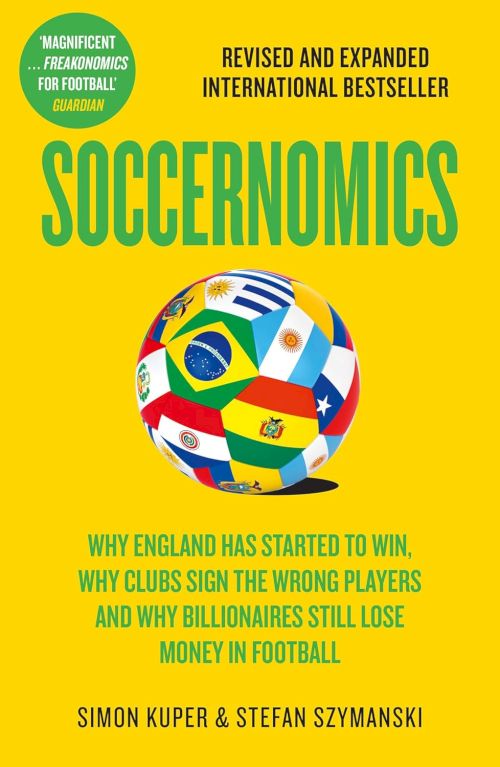
Soccernomics is a wonderful book. With the 2026 World Cup as backdrop it’s a great summer read – accessible, quirky but ultimately putting the world’s biggest sport under an analytical lens.
The authors – journalist Simon Kuper and economist Stefan Szymanski – use a mixture of history, data, accounting, psychology and of course economics (even econometrics) to present a compelling narrative about football. They discuss questions you might have pondered – such as whether managers really make all that much difference and why player wages are so high. They also address questions you might not have considered – such as why clubs ultimately survive despite significant losses, bankruptcy and even the dreaded relegation. They don’t dodge issues – racism, suicide and sexism are all put under the spotlight.
Economists will particularly enjoy references to game theory, efficiency wages and regulatory capture. Football fans will find references to famous games, players, coaches and quite possibly even a club they support. If you enjoy both then you really will be happy.
The book’s appeal is broader than football-loving economists though - or economics-loving footballers for that matter. Given football’s pervasiveness globally anyone interested in culture would find it interesting. Public policy makers would also benefit from understanding how it differs from a traditional business and the impact of major sporting events. Those with an interest in history would enjoy the discussion about how the industrial revolution and demographic changes shaped the clubs. It ought to be required reading for all FIFA officials.
Soccernomics is incredibly well written and researched. The benefits of a journalist and economist writing together are clear. The book does a really good job of blending statistics with anecdotes and more than once I laughed out loud. It also joins an increasing number of economics books with popular appeal beyond the profession. The Guardian is quoted as calling it ‘a sort of Freakonomics of football’.
Soccernomics is a decent sized book with 469 pages spread over 22 chapters. You can dip in and out of chapters depending on your interest, e.g. there is a chapter on penalties, a chapter on happiness and even one on Major League Soccer.
This is a revised 2026 edition with the original book released in 2009. This allows the authors to comment on recent developments as well as revisit their earlier findings. I will be looking out for what the authors make of Presidential involvement in red cards in a future edition.
Football is a much-discussed sport and everyone has a view. Be warned though – after reading this book you may find yourself quoting statistics and evidence to back up your points. On joining a World Cup match viewing during a penalty shootout I found myself quoting statistics on the probability of each team winning!
More Book Reviews
All Reviews
Expectations Matter
Aeons ago, it was a given that interest rates did not affect investment – and then it turned out that interest rates had been low and stable and so a lack of...
Bankers' Trust
Commentators on international finance have for a long time been fascinated by the characters of leading central bankers and their personal relationships. Aditi...
Recession
Thankfully, past periods of economic expansion have tended to be far longer than periods of economic contraction; indeed, the incidence of the latter has been...