Aeons ago, it was a given that interest rates did not affect investment – and then it turned out that interest rates had been low and stable and so a lack of variation had made it impossible for economists to observe or for market participants to pay attention to an impact which became highly visible when interest rates became high and volatile. Attitudes, perceptions and attention spans matter.
Slightly fewer aeons ago, I looked after the CBI’s business surveys which focused on what was going on in real time in the economy. The questions were based on quite large bands or bins of answers – often up, down or same. Nonetheless, we were able to use this fairly qualitative data to challenge the official figures for manufacturing output and for a while there was a ‘survey adjustment’ to the initial estimates. Surveys matter.
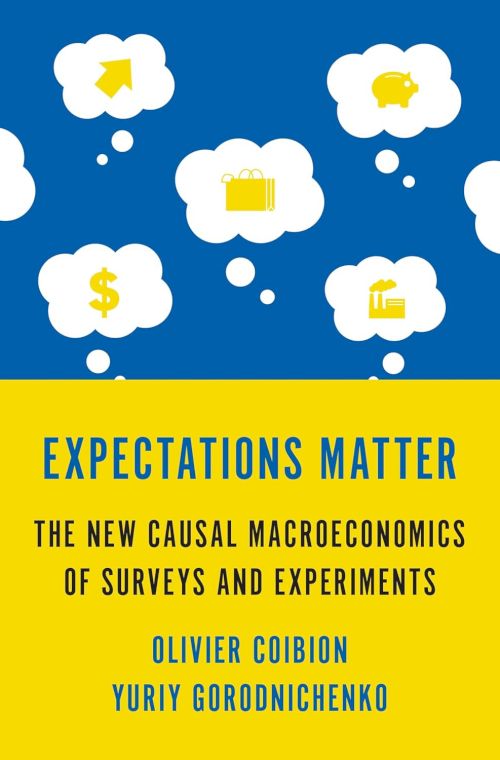
The background outlined above helps to explain why I was taken by the premise of this book and its focus on empirical evidence and detailed, individual consumer and firm data.
While the book can reward the kind of straight through reading that a reviewer needs to give it, it should also be a reference volume on the shelf of every economist interested in bringing evidence to bear upon decision making. While this book concentrates on inflation expectations, I think its messages and tools should be taken to much more general.
To start with, the authors focus on that important and tricky question of measurement. Two big sections, taking up more than half the book, concentrate on how to measure expectations, and then how to measure how they might change in response to more information, shocks or hypothetical scenarios – information treatments.
The authors had originally been brought up short by an editor of the American Economic Review who challenged what they had thought was an interesting paper about how expectations are formed, with a response that he did not necessarily believe that such expectations would be important. If it is any consolation, I too would have been taken aback. While it is certainly of immense importance to show how expectations pass through into decisions, a prior is surely to gather proper empirical evidence of what they are and how they are formed, without which everything else is just a set of assumptions.
Indeed, I remain concerned that too often empirical results which do not conform to prior theory can be rejected, instead of being used to challenge those priors and refine theoretical approaches. In this vein, a powerful result is that the link between inflation expectations and economic outcomes appears to be viewed quite differently by different groups. Trained economists ‘know’ that there is a trade-off between inflation and unemployment. Yet firms and consumers appear to view the world quite differently and will plan to cut back investment and employment when inflation is expected to fall – their trade-off runs the other way. The authors investigate this phenomenon in a variety of ways and using different data sets and information treatments and it seems to be fairly robust.
Here is a phenomenon which would be hard to incorporate into a full information rational expectations system. The authors indeed argue that it is a dead hypothesis. But what therefore we do need is something to put in its place, which may well require either a more nuanced view of adaptation or perhaps a willingness to look at macroeconomics in a different way.
The third and fourth parts of the book look at exactly the problem of how expectations affect decisions. This is quite tricky. Having measured expectations carefully using survey data, and used information treatments to conduct randomised controlled trials, linking these to outcomes provides a new set of empirical challenges. While external administrative data might the gold standard here, it is more usually than not unavailable or cannot be directly linked. So further survey data and self-reporting is needed and in turn need to be checked for relevance. I would have liked to see a broader discussion of time here – we are all used to the maxim that it takes around two years for macro policy adjustments to have their full effect. It seems likely that the authors’ approaches could be used to test in more detail and with better segmentation how far that is really supported. It can take a generation successfully regenerate a decayed neighbourhood – think Docklands in London – but changes in financial markets can react in real time to rumour and changes in attitude. Unpacking this would add to both our understanding and potentially to improving a sense of what macro policy can – and cannot – achieve.
The authors end with a story which illustrates this, to my mind, nicely. They point out that in 2020, the Fed introduced average inflation targeting (AIT). This was intended to improve how inflation policy could work by operating through household inflation expectations. The authors ran a series of surveys to assess how the announcement was heard by the public and affected their beliefs. It did neither. So at least some of the impact which theory suggested was very unlikely to occur, diluting much of the potential benefits.
Theoretical confidence may not be matched by empirical results in the noisy world which we actually inhabit and things to which economists pay attention as a matter of routine can be invisible to those who are expected to be influenced.
I hope this book gets the attention it deserves and informs those who now run all the many surveys that exist out there. Equally, I hope it helps them provide useful survey data with real impact, not just a few misleading headlines.
More Book Reviews
All Reviews
Yesterday: The United Kingdom from Thatcher to Covid
This is an authoritative history of a period which represents most of my working lifetime. A quick clarification, however: that period runs loosely from Mrs...
The Winner’s Curse
It would be cheeky of me to say there is no need to review a book partially authored by a Nobel economic prize winner that is in its third edition. That...
AI for Economists
I started reading this book just as the UK Government announced the setting up of an AI Economics Research centre chaired by Nobel Prize laureate Simon...