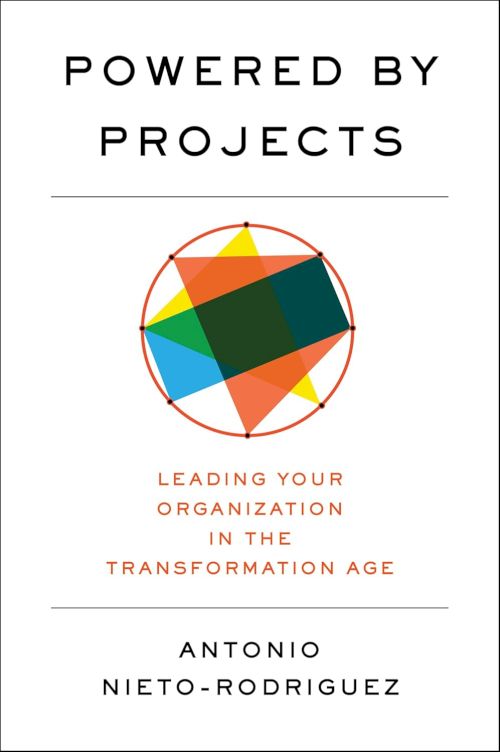
This is not an obvious book for macroeconomists to pick off a bookshelf, but it is nonetheless a good one. The author motivates us by a powerful narrative. Companies once focussed upon the operational improvement of stable, repeatable processes. Then, for the two decades when software moved up the hierarchy, leaders had to devolve more decision-making agility to teams. They solved and released in sprints. But what if the whole enterprise needs to keep transforming? Nieto-Rodriguez, a visiting professor at leading business schools and a global leader in project management, argues that now the project-driven organisation will be a dominant form.
Digital technologies now spread so rapidly that firms must continually migrate and update their data into modern formats and then quickly drive useful adoption. These transformations are complex because leaders have no choice but to replace digital infrastructure while it is in use. Also, they require ever more cross-specialist collaboration; all the different modern “guilds” work on the build together; everyone becomes an engineer. Favourable market conditions also matter, and so financing can be spasmodic and needs trust from investors. Thus, the book is about how leaders should run businesses if projects are at the heart of strategy, growth, value creation, operations, and culture.
The book will appeal to those who seek a cure for the modern headache of complex project governance and ownership at the enterprise level. As someone who has governed a few grim projects of this type, I found the book to be a good guide. It offers a comprehensive framework. But it also has excellent tips. Take the Project Canvas. This is a one-page template with the key information on the project, transparent to all. Also, he is honest that if we want lean governance instead of heavy oversight at the pace he envisages, we can back only a few key initiatives. My heart leapt with joy when he urged leaders to prune failing or finished projects. One measure of success is then how many projects are live, and how much of the best people’s time they absorb.
I would say that that the book overstates how far AI-driven predictive analytics will help — and many readers will be tempted to go further still. Yet I see that the limits of predictive analytics keep showing themselves even as computing power continues its exponential trajectory:
At the risk of a digression, any unproven faith in AI predictive analytics to me is just technological solutionism, a dogmatic belief that every complex human, social, and political problem can—and must—be solved with digital tools (Morozov, 2013). In an earlier time, Theodore Porter in his history of objectivity showed that firms reach for hard numbers not where trust is strong, but where it is weak; numbers stand in for judgement once shared trust breaks down. This is surely apparent when we watch football where video assisted referee technology will annoy and infuriate. In her highly recommended book, Daisy Christodoulou uses this example to show the harm that happens when we push out expert judgement and trust in process when inferring from complex human behaviour.
Not that humans are perfect at project prediction. When talking about megaprojects, Flyvbjerg and Gardner (2023) found two forces drive the overruns: optimism bias and strategic misrepresentation, where sponsors understate costs to win approval. Only 8.5% of major projects come in on time and on budget — and once you add delivering the promised benefits, that figure collapses to 0.5%.
Powered by Projects is therefore a useful book. Digital technologies do not make a firm less behavioural and less political. Project management will always need people to meet, argue, weigh transparent evidence about what is going on, fess up, and correct course. The author might be right that enterprise projects are more mainstream than backwater. The outcome of using the book can then be a common language for governance, clearer mandates, and more autonomy.
Christodoulou, D. (2024) I Can’t Stop Thinking About VAR. London: Swift Press.
Flyvbjerg, B. and Gardner, D. (2023) How Big Things Get Done: The Surprising Factors That Determine the Fate of Every Project. New York: Currency.
Morozov, E. (2013) To Save Everything, Click Here: The Folly of Technological Solutionism. New York: Public Affairs.
Porter, T.M. (1995) Trust in Numbers: The Pursuit of Objectivity in Science and Public Life. Princeton, NJ: Princeton University Press.
More Book Reviews
All Reviews
The Price of Money
While a member of the MPC at the Bank of England, considerable time was devoted to thinking about two important concepts; the size of the output gap and the...

Money Beyond Borders
This book is both easy to understand and pretty entertaining. Barry Eichengreen, Professor of Economics and Political Science at the University of California,...
A Century of Plenty
Walk into the non-fiction or economics section of any bookshop and you will likely be greeted with a familiar sight. Displays of piled up books pointing out...