
10 November 2025
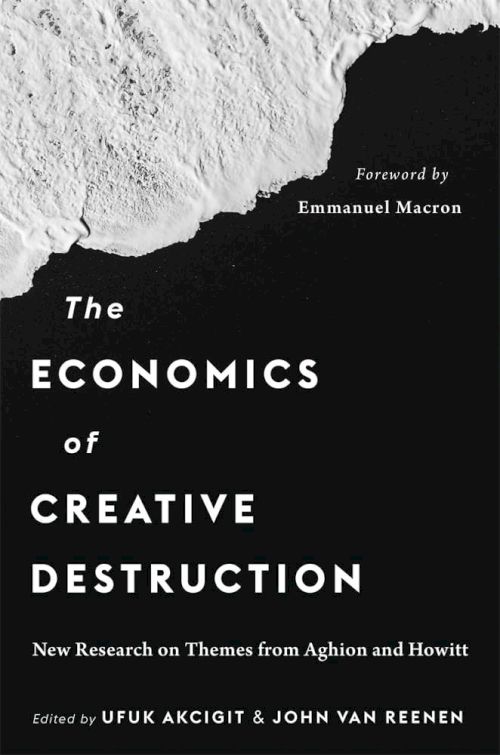
The Economics of Creative Destruction
New Research on Themes from Aghion and Howitt
Ufuk Akcigit and John Van Reenen
2023, Harvard University Press, 784 pages,
ISBN 9780674270367
Author: Ufuk Akcigit and John Van Reenen
Reviewer: Neil Reeder, Head and Heart Economics
In his 1942 book, Capitalism, Socialism and Democracy, Joseph Schumpeter saw “new methods of production or transportation, new markets, new forms of industrial organization” as a process of “industrial mutation … that incessantly revolutionizes the economic structure from within, incessantly destroying the old one, incessantly creating a new one”. Creative destruction, he argued, was nothing less than “the essential fact about capitalism”.
Intuitive instances of such processes are not hard to find. ChatGPT and large language models have set off a colossal investment spree in artificial intelligence and shaken and reshaped hiring patterns in many industries.
Yet Schumpeter’s insights “were notoriously difficult to incorporate into formal economic models” (in the words of editors Akcigit and Van Reenen). Consequently, Philipe Aghion and Peter Howitt’s 1992 paper “A Model of Growth Through Creative Destruction” was groundbreaking and has become one of the most cited papers in modern economics.
By bringing in thinking from industrial organization, it integrated growth theory with themes of firm dynamics, competition, and incentives. In the decades since publication, the debate has broadened to considerations of inequality, regulation, finance, taxation, trade, and political economy.
Building on papers initially presented to a 2021 academic conference, Economics of Creative Destruction showcases a wide selection of themes in its 26 main chapters. As well as varying in themes, the papers vary greatly in terms of technicality, from discussive (such as by Nicholas Stern on creative destruction and climate change, and Edmund Phelps on innovation and growth policy), to detailed equilibrium models of households, government and production.
This inclusion of technical detail, on occasion, means that the 750 or so pages of the book are not always easy reading, yet the chapters reveal important insights.
The chapters reveal an ongoing debate as to what has caused a slow-down in productivity growth in the USA and Europe since the early 2000s. Some argue that it is low interest rates (which enable “zombie firms” to survive), or that simply “good ideas are getting harder to find.”
However, a major strand of thinking is that corporations are acutely aware that their market positions could be undercut by new entrants with new innovations and so undertake acquisitions and/or undertake lobbying with government to prevent this occurring (echoing case studies set out by Cory Doctorow in his recent book Enshittification).
There would appear to be much for central government and regulators to take on board from this, and from findings that trade barriers lessen knowledge transfer as well as having direct effects on costs and prices, reducing companies’ incentives to innovate if imports are reduced. There are also policy implications for education and business support, with a need to overcome a marked tendency for innovators to achieve their potential only if they are supported by parental wealth. More generally, in their chapter on inequality and creative destruction, Richard Blundell and colleagues point to ways by which better outcomes can be achieved for both inequality and innovation.
Economics of Creative Destruction: New Research on Themes from Aghion and Howitt, therefore, highlights the ways in which macro and microeconomic research have been brought together since the original 1992 paper. Consequently, it is perhaps no surprise that Phillipe Aghion and Peter Howitt were awarded the 2025 Nobel Prize for Economics (along with Joel Mokyr, who contributes a chapter to the book).
But the agenda is very far from being played out, not least because the book is relatively light on such key issues as social innovation, the creation of a widespread culture of innovation (“Mass Flourishing”, to use Edmund Phelp’s term), and the ways in which the innovation eco-system can be strengthened.
In their conclusion to the book, Aghion and Howitt state that “capitalism cannot be fully dynamic unless it is inclusive; it cannot be fully innovative if vested interests prevent the emergence of new talents” - Much further research and policy reform is required to fulfil that goal.