
25 March 2026
On Natural Capital – The Value of the World Around Us
Partha Dasgupta
2025, Ebury Publishing, 288 pages,
ISBN 9781529144192
Author: Partha Dasgupta
Reviewer: Kate Barker, Universities Superannuation Scheme
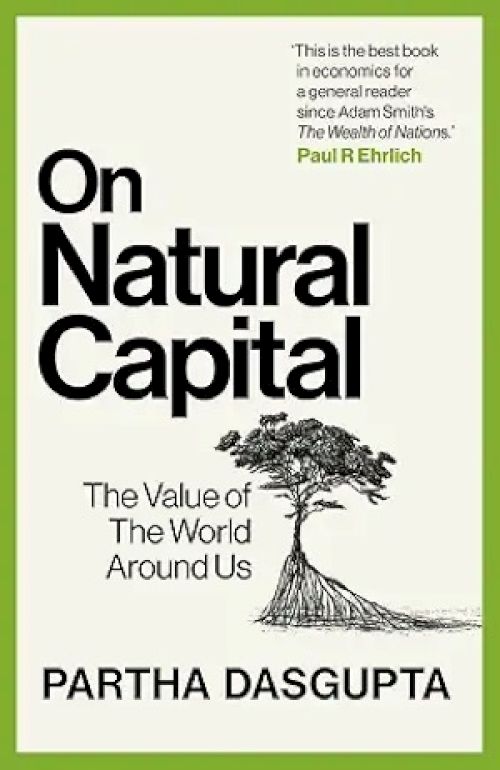
Dasgupta’s aim is to make the messages and conclusions of his Review* accessible and urgent to the general reader – albeit one who “is prepared to work hard with me”. In this he is successful, and many economists will probably also learn much from it. He challenges the approaches taken by our profession – criticising much growth and poverty economics for omitting our embeddedness in Nature, describing this as ‘an elaborate exercise in collective solipsism.’ It is also a provocative read for those considering how best to include biodiversity considerations in investment choices.
By now we are all aware that Nature is an asset, and one which is both varied and interconnected. Perhaps it’s less often explicit that we are wholly dependent on Nature as the producer of so many of our goods and services, and that this differs from produced capital as damage can be irreversible, and ecosystems can collapse.
Dasgupta draws on the classification of ecosystems into Provisioning (goods we harvest or extract); Maintenance and Regulating (controlling erosion, regulating the climate) and Cultural Services. It is interesting, but also alarming, to read that there have been five historic mass extinctions – though reassuring for the earth (if not for us) to know that following each one biodiversity increased. At present, species extinction (now occurring at an alarming rate) is often due to habitat reduction – the area of habitats matters.
His key point is that we should be sharply aware of the impact of human population and the way in which it consumes and affects nature. We face a tussle between our demands for provisioning goods, and our longer-term need to preserve natural capital stocks. The Impact Inequality, defined as a situation where humanity’s demand for provisioning goods exceeds the biosphere’s regeneration rate, suggests a limit to total global GDP (unless we believe that GDP can be produced with ever fewer provisioning goods per unit). However, today the issue is that we are beyond that limit as the best estimates suggest we are in a situation of Impact Inequality. We have moved out of balance not because we don’t care about the future, but because of well-known factors such as externalities or open access goods.
Optimistically, Dasgupta argues that we could recognise the importance of collective choices in how we live. The first choice is demographic, noting the failure of the UN’s Sustainable Development Goals to recognise the issue of population. Contentiously, he has little time for the worries about declining population in developed countries. The second choice is to pay for what we use, including the externalities, and on the positive side to pay for the provision of eco-systems. He also hopes for shifts in societal norms to move behaviour towards managing nature. We have allowed battles for resources to undermine communitarian habits of managing local commons.
Being an economist, he sees it as important to seek to measure the worth of natural capital. Examples include the environmental costs of some forms of farming, and the amenity value of natural assets. But the main conclusion is that while produced and human capital assets have been rising, natural capital is being diminished. If we account for this, global wealth per head has been declining.
Dasgupta wants to see policies which lower population, lower GDP per head, reduce our call on provisioning goods and boost Nature’s regeneration. It’s a tall ask. We would have to reduce subsidies for food and energy, pay for use of global commons and deal with the economics of trade leading to biodiversity loss in poor countries. He comments “in poor countries the term ‘economic development’ is routinely used to justify appalling investment undertakings”. Consequently, the policy solutions proposed include international taxation systems, nudges to behaviour and work on nature restoration.
He points to a loss in many cultures of the spiritual regard for Nature. But this is balanced by a thought-provoking and moving account of how we perceive our role in the world, and our embedded care for the future. From this, Dasgupta sounds reasonably optimistic – and seems to suggest that a clear-eyed realisation of the risks to the future caused by our present way of life will lead to support for the desired changes.
Yet given the stuttering response now to the risks from climate change (despite its impacts being very evident), it’s hard to share this optimism. At the end of the book he comments: ‘In examining our values and thus our lives, we are led to ask whether the destruction of an entire species-habitat for some immediate gratification is something we can live with comfortably.’ Unfortunately, I fear too many of us either don’t ask this, or find we can indeed live with it comfortably.
*The Economics of Biodiversity: The Dasgupta Review HM Treasury 2021